

V. Shantaram’s Teen Batti Char Rasta gives me a perfect opportunity to continue my recent trend of comparing old movies to one another, because this one immediately reminded me of a couple of others that I’d seen. When I saw the opening scene, with the household containing five daughters-in-law speaking languages from five different Indian states (in addition to two parents who come from different places, and all those sons who must be considered an odd combination), I immediately thought, oh, so this is a comedy about the need for Indian unification, and the Vyjayanthimala starrer New Delhi (1956) came to mind.
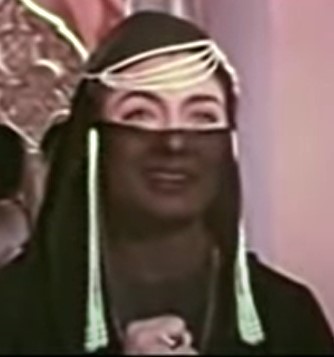
But when the story of Sandhya’s character Kshama comes out, it turns out that there’s another moral even more prevalent. Now, I was thinking of the 1952 Pakistani film Dupatta. Back when I wrote my review of Dupatta, I talked about the line spelling out the moral near the beginning, “Love doesn’t depend on beauty” (uttered by a doctor who is obviously unable to do some requested plastic surgery), and I said, “Of course, we are never quite sure if this moral would work the same for the characters involved if the gender of Beauty and the Beast were reversed.” But now, with Teen Batti Char Rasta, the situation is posed with the genders reversed…sort of. There’s a difference, though. Dupatta revolves around the story of a man who’s been badly burned in World War II (within a story told to a woman whose husband has been badly damanged in a car accident), and we know even before we see him that he’s going to be damn ugly. But Kshama doesn’t look deformed in Teen Batti; she’s just looks like Sandhya with a lot of dark makeup on. In fact, if you ask me, she’s quite cute and adorable. I don’t know if this trick was deliberate – maybe to reinforce the idea of how silly it is in India to consider dark skin a sign of ugliness? – but in any event, it took me some suspension of belief to consider Sandhya as the ugly duckling who everybody wants to shun upon sight.
But Kshama also has another identity, the radio singer Kokila, whose voice is considered very beautiful. And that makes sense since, after all, her voice is Lata Mangeshkar’s, and these are some of the sweetest Lata songs I’ve ever heard! (I especially like the song I posted the other day. Of course, credit should also be given to the music director, Shivram Krishan.) So, it makes sense that Kshama, who is taunted and insulted constantly because of her looks, would find it very rewarding to be a singer on the radio, where she, as Kokila, is very much admired. The DVD subtitles might get it wrong sometimes…

…but it’s clear that her natural medium is RADIO.
But then what happens when somebody forms a picture in his mind based on her voice on the radio and then finds out what she really looks like? That’s the centerpiece of the drama that unfolds in Teen Batti Char Rasta. This drama really gets underway when Kshama gets a job as a maid in that household with all the daughters-in-law from different states and encounters the sixth, unmarried son. This guy, Ramesh, played by Karan Dewan, is apparently considered a real handsome devil…

Though I’m not so sure myself – personally, I think Dewan looked a bit better nine years earlier, in Ratan. Still, everyone expects that Ramesh will find himself a beautiful wife – especially since he is some kind of writer and artist to boot (and not the poor kind of artist or writer either). Ramesh, meanwhile, is completely in love with the voice of Kokila, but since he has no idea that she and Kshama are the same woman, he creates his own picture of her, based on his mental impressions, that is a bit off the mark…

When Kshama sees this picture and finds out who it is supposed to be, she immediately dreads the thought of Ramesh learning that she is the real Kokila. But unfortunately, she can’t avoid this discovery one night, when Ramesh stalks her after a radio performance. For a while, he is able to see her only from behind or at a distance, but when he finally catches up with her and notices that she is entering his own house, there’s no disgusing the truth anymore. After this, there are a couple of unpleasant scenes in which he tells Kshama outright that he has been devastated by the discovery that she is Kokila, because it has dashed his hopes, ruined his aspirations, etc. Kshama stands up to Ramesh a little, but neither she nor anybody else informs him how insulting his behavior really is, nor is there any mention that maybe there’s something a bit creepy about stalking one’s favorite radio star across town. In any event, Kshama disappears in shame for a little while, and this is when we begin to see signs that maybe Ramesh is starting to fall for the real Kshama…

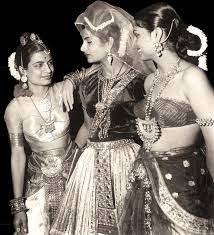
And that is probably the dramatic peak of this movie that is for the most part pretty light fare, though it is memorable as well as fun, mainly for the performances by Sandhya. Having seen Sandhya in Navrang and in many dance scenes from other films, I knew that she had qualities as an actress, but I didn’t realize that she could be so much fun as an actress even in a movie in which she’s acting much more than she’s dancing. She does have a few really nice dance scenes here – especially when she is relating news about her feelings or the events of her life to her poor and ailing father – who for some reason always brings out the dancer in her…

But most of the work that Sandhya does in this film is straight acting and a lot of wonderful miming to Lata’s voice. She generates much sympathy in the many sad moments that this character goes through, but for the most part, she seems just right for what is essentially a zany comedy. (Somewhere toward the end of the movie, in one of a few plot twists I won’t go into too much, some jealous people give Kshama a powder to drink that causes her to lose her voice, without any idea if or when it will ever return. It’s a terrible thing to happen to her, but on the other hand, the hoarse voice that Sandhya puts on for this part of the movie is quite funny.)
V. Shantaram’s direction for this film is sometimes quite zany too, though it actually seems a little less fantastic and more realistic than in, say, Navrang, or in the many clips I’ve seen from other movies that he made in the 1950s. He keeps the off-the-wall touches relatively minimal and light, and when he does get kookier, it’s to very nice effect, as in the final number, “Teen Deep Aur Char,” which left me smiling for a while afterwards…

 Dances on the Footpath

Sounds like Raj Kapoor’s idea for Satyam Shivam Sundaram wasnt all that original, after all! It also has a heroine with a lovely singing voice but a less than attractive face – in her case its a burn scar covering one half of the face. The hero falls for her voice and rejects her when he sees her face – something that also made no sense as the heroine was Zeenat Aman who looked sizzling, inspite of the scar!
PS: Love that last screen cap of spinning Sandhya – great “moving” picture! :-)
Hi, Bollyviewer. Yes, it looks as though V. Shantaram got to that territory much earlier.
I am glad that you like the last screen cap. It’s always so difficult to get a good cap of someone in the middle of a dance!
Thanks for another engaging review of this V.Shantaram movie.Though not critically acclaimed is in my perception is a wholesome family entertainer. Satyam Shivam Sundaram do have this theme of Zeenat Aman playing a scar faced girl covering her dupatta throughout the movie to hide her ugliness.
But then Raj Kapoor excessively focussed on Zeenat Aman’s body with revealing costumes and the message perhaps was lost in the whole affair.V.Shantaram gave a dark make-up to the central charachter and it is doubtful if any other leading lady of the time would have agreed to do the role.On this aspect Sandhya scores a point.
The charachter blends with the script in not only garnering sympathy from the viewers, but also in communicating the intended message in a straight forward manner.
Saw this long back, but I remember feeling very sympathetic towards Sandhya’s character (I’m a good deal darker than my elder, more beautiful sister, and one of my earliest memories is of my grandmother saying, “Ah! You’ve grown up a bit, haven’t you? And not looking so dark, either!” Took my mum, my father and my sister a bit of time to convince me that dark doesn’t mean ugly – though to my very old-fashioned grandma, it definitely did).
Hmmm. I have to see this again. Weren’t Nirupa Roy and Smriti Biswas among the bahus of the family?
And I have to see Dupatta. I’d bookmarked it on youtube, but somehow haven’t got around to it yet.
Hi, Dustedoff. Interesting to hear about your personal sympathies with Kshama.
Yes, Nirupa Roy and Smriti Biswas were among the bahus here; I noticed that Shashikala was too.
Is Dupatta still on YouTube? I haven’t kept track of that… This was one “YouTube movie” that I actually saw on DVD instead, having found it in a Pakistani DVD store in Jackson Heights. But the technical quality of the reproduction was similar to a lot of what you’ll find on YouTube. :) Still, some of those songs will sound beautiful in any form…
Veda and Bollyviewer, between your two comments together, I get the impression that the Raj Kapoor movie was a bit off.
I’m not a big fan of Zeenat Aman anyway. I can think of at least three heroines in Raj’s movies of the ’50s and ’60s who “sizzled” a whole lot more. :)
Well, Raj Kapoor was always a bit notorious for focussing on his heroines body…standards just got more evident with time.
I remember my mum commenting when Karishma or Kareena appeared in skimpy clothes: it was fates way of avenging (well, something a lot more cruder in Punjabi!)
Yes, this dark=ugly thing is pretty standard. dustedoff, I have a relative who are a family with three stunning daughters, but the youngest one (the most beautiful of them all) was always jokingly being told that she had been “picked up” from the village!! (b___h___)…all in the name of humour: it is quite good that she is pretty strong character.
You only have to look at the ads in India: there is one currently where someone doesn’t get a job until she becomes fair using one of these fairness creams!
Back to Shantaram, I would really like to watch this film. I thought I recognised Shashikala but missed Nirupa Roy. Kshama sounds like a likeable character.
Richard, I’m hoping Dupatta is still around… oh, how I wish I had a couple of hours extra each day!
bawa: I can understand about your relative; unfortunately, being the butt of jokes like that begins to pall after a while, so it’s good she has a pretty strong character. And you’re so right – the mania about fairness is nauseating. I believe the Ministry of Health had planned a crackdown on ads for fairness creams, but obviously it hasn’t happened!
Oh this does sound good :) Will try to get to it soon (I’m with dustedoff on need more hours in the day, as long as they aren’t work hours :)
nice discussion. Those who r in Mumbai and saw earliest photograph and film footage of Lataji in documentaries and functions, would identify that Sandhya (Kshama) has mimiced dress, hair style, even coat and scarf in some scenes, laughter, mannerism all ditto lataji. Great actress indeed. It is as if Lataji is enacting this role.
– suresh
Suresh, thanks for the interesting comment. Yes, now I recall reading somewhere that Sandhya was actually mimicking Lata in this film. I have seen old pictures of Lata wearing that braid, and I can see the similarity there, at least. :)
Pingback: Carnival of Blogs on Golden Era of Hindi Film Music – July 2013 | The world is too small? or Is it?
Hi,
V.Shantaram well ahead of his time made film on unity in India. now after 60 years I find India in very sorry state. Politically, language and castewise ideas have changed or gone back.
sham
Hi,
I saw this movie today on TV and when searching for info on it, happened upon your nice review.
I just wanted to point out that Raj Kapoor had an ongoing theme of “Surat vs. Seerat”, i.e. “Beauty vs. Soul” in his movies. For example, it was in Aag in 1948, he touched upon it in Shree 420 in 1955, and it was a major part of the story in Satyam Shivam Sundaram of 1978. I read somewhere that he even worked on a story idea for a film of that name.
On another note, Sandhya’s name in this movie is Shyama (meaning Night) and not Kshama (meaning Forgiveness). Her name was in keeping with her appearance, hence I thought it worth pointing out.
– priya
Priya, thanks for your nice words and your interesting observation re. Raj Kapoor’s films.
Regarding the name of Sandhya’s character, I watched this film on an English-subtitled DVD in which her name was spelled out in the subtitles. The subtitles had to have said “Kshama,” or I wouldn’t have referred to her as Kshama. (Unfortunately, I am not presently in the same place where the DVD is stored, and I am not even sure that I will be able to play it once I find it. As the post date shows, I watched this film and reviewed it almost eight years ago. But I don’t think there’s any need to double check re. what happened, because I would never have misnamed her based on hearing alone.)
Just now, though, I have checked listings at Wikipedia and IMDb, and they also both say Shyama. So, I think I will correct that (not this minute, but soon). Thank you for pointing that out!
I understand about the subtitles.
Btw, I am in awe of people like you and Memsaab and several others, who have developed deep knowledge in the area of Indian films, despite not having easy access to it from childhood, unlike those of us born in that culture. Makes one think whether there is something to be said for rebirth. Maybe you were an Indian actor or director in your last birth.. am only half joking.
Thank you for the nice words, Priya. You are not the first one who has expressed amazement and awe about this sort of thing. To me, though, that amazement, itself, is a mystery. I think, maybe, in my case, at least, I had easier access to Hindi films than you’ve realized – maybe not in my childhood, but certainly, starting in my 40s! (I wonder if Greta Memsaab might say the same thing, since she is almost exactly the same age as I am and started her blog somewhere around the same time. Actually, a few of us started our blogs at around the same time, within a few months of each other, and I sometimes wonder how that happened; that might be the real mystery. :) )
In my case, I happened to live in the famous Indian neighborhood named Jackson Heights, Queens, during a time when there were at least a dozen stores selling classic Hindi DVDs for very cheap (or very cheap at least by U.S. standards). Unfortunately, almost all of those stores have closed since then or have gotten rid of their stocks of DVDs, so I guess I lived there at just the right time to do the browsing that I enjoyed so much.
People might find old Indian films online now, but to me, it is not the same experience as being able to walk into a store and look at things that are physically in front of you and pull a few dollars of cash out of your pocket. (By the way, for various reasons, I almost never buy things online.) But as consolation, I am happy to say there are more very old Indian films available on YouTube (with quite a few of them – especially the subtitled ones – coming from our friend Tom). I also have indulged in YouTube song clips all along, and sometimes if I saw a clip that I really liked, I’d look up things about it and about the artists involved, etc.
Anyway, I have to thank you for your compliment for another reason, because it gave me an idea of how to end my ten-year-anniversary post (which I just wrote). There, too, I am trying to explain that I saw, I bought, I read a little, and that was it, and there’s no reason to think there is any great mystery here!
But on the other hand, I do appreciate getting such compliments; they actually help me to keep going here. :)
Just came across this review, Richard, because I found this movie while trawling the web and wanted to see what it was about.
Sounds interesting, so I shall go see it, though Sandhya is not one of my favourite actresses. (My opinion of her acting talent differs quite a bit from yours. :) )
And I agree with Priya – the idea for Satyam Shivam Sundaram was in incubation a long time. Raj Kapoor was inspired by Lata Mangeshkar (she had chicken pox marks on her face, I think) around the time he was making Aag which was well before this film was made. In fact, RK wanted her to act in it.
Anu, thanks for looking at this review. (It’s a long one… Well, it’s been eight years since I wrote it. Back then I was writing more long, full, straightforward film reviews…)
It’s too bad that you don’t like Sandhya, but I know she’s a bit controversial. I do think she’s a good actress. I love her dances, though that’s also something some people give me a few arguments about. :)
I’ve actually never seen Satyam Shivan Sundaram. I think the latest Raj Kapoor-directed film that I ever saw was Mera Naam Joker.
That would have been interesting if Raj Kapoor had gotten Lata Mangeshkar to act in a film in or around 1948. I know she acted in one in 1945, but unless I’m mistaken, that was the end of her time on screen.
BTW, when you referred to Priya’s comment of last summer, that reminded me that I really should change the name of Sandhya’s character from Kshama to Shyama. I said I would do it “soon” four months ago. I guess it hasn’t been my highest priority but I will get to that, hopefully within the next couple of days (but for now, I have to say “not this minute” again. :) )
Pingback: Teen Batti Char Rasta (1953) - Naa Songs